Why Most Small Businesses Don't Need AI (Yet)


Every week, a business owner tells me some version of the same story: "Everyone's talking about AI. I feel like I'm falling behind. But I don't even know where to start."
Here's what I tell them: You probably don't need AI. At least, not yet.
I know that sounds strange coming from someone who builds automation systems for a living. But after a decade of helping businesses across Africa and the United States run better, I've learned something that the AI hype machine doesn't want you to hear: most small businesses have problems that don't require artificial intelligence to solve.
They require better systems.
The Automation Ladder
Think of business improvement as a ladder. Most companies try to jump to the top rung — AI — when they haven't even built the bottom ones.
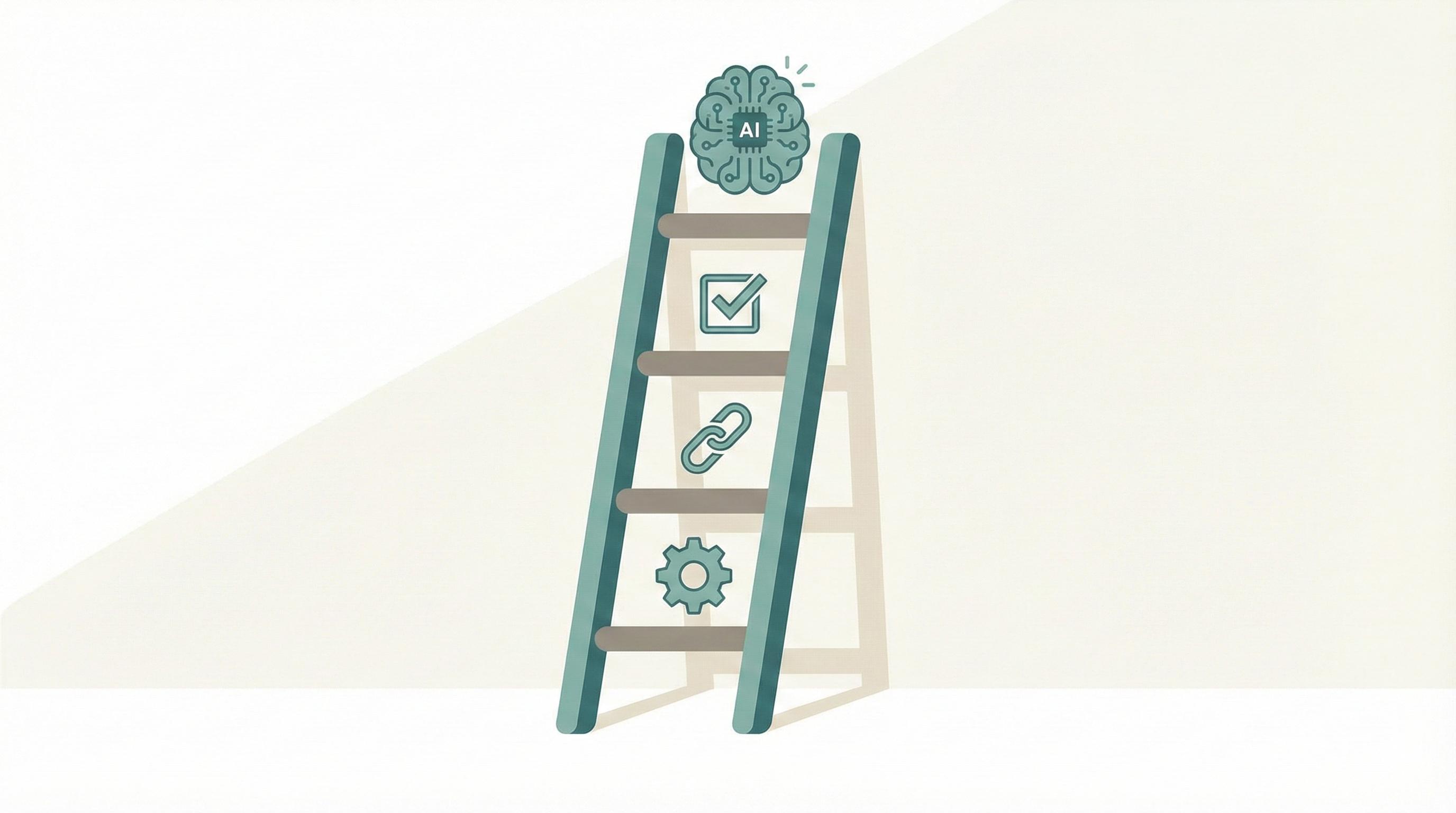
The ladder looks like this:
Rung 1: Process clarity. Do you actually know how your business runs? Can you draw your workflow on a whiteboard? Most businesses can't. The owner holds everything in their head, and the team operates on tribal knowledge. No amount of AI fixes this. You need documentation, clear handoffs, and defined responsibilities.
Rung 2: Tool consolidation. Are you using 7 different apps that don't talk to each other? Your CRM doesn't connect to your invoicing tool, which doesn't connect to your email, which doesn't connect to your spreadsheet. Before you add AI, just connect what you already have. A simple Zapier flow or Make.com automation that syncs your tools can save 5-10 hours per week — no AI required.
Rung 3: Simple automation. Rules-based, predictable tasks. "When a new lead fills out the form, send them this email, add them to this list, and notify the sales team." This is automation, not AI. It's reliable, cheap, and solves 80% of the "busywork" problem most businesses complain about.
Rung 4: AI-assisted workflows. Now — and only now — does AI make sense. And even then, it's usually for specific tasks: summarizing long documents, drafting initial responses to customer inquiries, extracting data from messy files. AI as a tool, not as a strategy.
The Real Question to Ask
Instead of "Do I need AI?", ask yourself: "Where is my team spending time on work that follows a predictable pattern?"
If the answer involves copy-pasting between tools, manually sending the same emails, re-entering data, or searching through folders for documents — you have automation opportunities. Some might use AI. Most won't.
When AI Actually Makes Sense for Small Businesses
AI earns its place when you're dealing with unstructured data or judgment-heavy tasks at scale. A few examples that genuinely work for small businesses:
A law firm with thousands of contracts that needs to search across all of them instantly. A medical practice that gets dozens of patient inquiries daily and needs to triage them automatically. A logistics company that wants to predict demand patterns based on historical data.
Notice what these have in common: high volume, unstructured inputs, and a task that would be impractical (not just slow) to do manually.
If your problem is "my team wastes time on repetitive admin" — that's an automation problem, not an AI problem. And automation is cheaper, more reliable, and faster to implement.
What We Tell Our Clients
At 82Brands, we start every engagement by understanding how your business actually runs. Not by pitching AI. Sometimes the recommendation is AI. Sometimes it's connecting your existing tools. Sometimes it's redesigning a process. Sometimes it's all three.
The businesses that get the best results aren't the ones that adopted AI first. They're the ones that fixed their foundations first.
If you're feeling pressure to "do something with AI" but don't know where to start, maybe the right starting point isn't AI at all. Maybe it's getting honest about where your business is actually losing time — and fixing that first, with whatever works.
That's what we do. And if AI is the right tool, we'll tell you. If it's not, we'll tell you that too.